Legends and Stories
The Importance of Legends and Stories Video

Every nation under heaven at Pentecost.

Image of Eusebius of Caesarea

The Legend of Joseph of Arimathea arriving in Cornwall with his nephew, Jesus.
As well as using factual information I also use a lot of stories and legends on Prophecy Workshop. I have done videos on King Arthur, Dragons, Giants, the visit of Joseph of Arimathea to Glastonbury, Drake’s drum, the little people under the earth and so on. These tend to be stories that hover between myth and reality but to me they are important.
From a prophecy point of view, when looking at history we can firstly use the bible. Then use reliable historical sources and we can also use sources that are not fully verifiable. We can use legends and myths.I think all are important. If history was just facts and dates no one would care about it. However the stories that bring colour to the facts are what what inspire us.
An example of what I am talking about is the history of the introduction of Christianity to Britain.
First we look at the bible. Act 2:5 says that devout men and women were gathered from every nation under heaven at Pentecost.
[Act 2:5 KJV] 5 And there were dwelling at Jerusalem Jews, devout men, out of every nation under heaven.
Also in the Book of Romans it says:
[Rom 1:8 KJV] 8 First, I thank my God through Jesus Christ for you all, that your faith is spoken of throughout the whole world.
So, the bible indicates that the gospel spread quickly throughout the world. Next we have documentary evidence that the gospels came to the British Isles very early. For example the early church historian Eusebius of Caesarea (AD 260–340), in his work Demonstratio Evangelica (The Proof of the Gospel), he stated: "The Apostles passed beyond the ocean to the isles called the Britannic Isles."
As well as such evidence we have a lot of other documents relating to the early church in the British Isles which may or may not be valid. For example William of Malmesbury in his Gesta Regum Anglorum ("Deeds of the English Kings") gives details of the establishment of the first church at Glastonbury but many people regard his writings as unreliable. We also have a vast amount of folklore relating to the early church in Britain. For example the songs of Cornish tin miners recalling the visit of Joseph of Arimathea to Cornwall and Somerset folklore recalling the visit of Jesus to Glastonbury. I Prefer to look at everything. The legends and stories are the things that involve us emotionally in history which, as many people have said, is “His Story”.
So, I prefer to consider everything and regard the stories as important. I’ve often heard people talking about the “drama triangle”. Most stories basically involve three main protagonists. The victim, the persecutor and the rescuer. Most action films involve these three but we also see it in myths and legends. There is something built into us that responds to this particular storyline. I believe that mankind basically knows it needs a saviour and there is an endless list of people who offer solutions and set themselves up as having the answers. However there is only one real saviour and that is Jesus Christ. That is why every story ultimately leads to him because there is no one else who can genuinely save us from death and give us eternal life.
Joseph's Visit to Britain.
How it could have happened.
Joseph's Visit to Britain Video.
In these last days I believe that God is revealing more and more of his mysteries to the world so that people can see more of His wonders. Already as I write there have been new discoveries about what lies beneath the Egyptian pyramids. More information is coming out about ancient civilizations all over the world some of which may have existed before the flood. I also believe that we will soon have more concrete evidence of Noah’s ark. There will always be false claims about things but the genuine new discoveries that are coming forward will serve to reinforce the accuracy of the bible. Remember there was a time when old encyclopedias said that Babylon was a legend. There was a time when the Hittite people were mythical. Archaeology has now proven these things to be real. Only bible believers really thought Israel would become a nation again until it actually happened in 1948.
In this video I am putting together the information from the two previous videos, on Cornwall and Somerset and imagining what Joseph of Arimathea’s visit to Britain would have been like. This is of necessity something of a flight of fancy. However there are some facts. There was a tin trade between Israel and Britain. There was always a Christian community in Britain, way before the arrival of the Catholics. There is a large amount of folklore about the visit of Joseph and Jesus to Britain. Traditionally Joseph was Jesus’ great uncle and brought Him to Britain on a tin trading ship. It's worth noting that the legends of Joseph and Jesus were alive and well in the west of England up until the mid 20th century. Fortunately several Anglican clergymen recorded the old stories, in the 1930s, for posterity. I will put some references at the end of the video.
Joseph could have easily have got a ship to Britain because the tin trade from Israel to Britain had been established at least since the time of King David. On nearing Britain he could have stopped at the Scilly Isles also known as the Hesperides or Blessed Isles. In the ancient world these islands were known as the Cassiterides. A point on one of the islands, Tresco, is named Merchant’s Point because it is thought to be the place where the Phoenicians came to trade for tin brought over from the mainland. After this legend says that Joseph and Jesus went to Cornwall and landed in the creek at St Just in Roseland.
There are also legends connecting them with Looe Island and St Michael’s Mount. These are all places where Joseph could have traded for tin. Following this they could have sailed round the coast to North Cornwall. There are legends connecting them with the Camel estuary where there is an ancient well known as the Jesus Well. from here they could have continued on their journey to Somerset. Legend has it that they rested at a place called Paradise which is the old name for the area around Burnham-on Sea. North of Burnham is the small port of Uphill which was used in ancient times. From here they could have travelled by river to Priddy and then past Godney (God’s Isle) to Glastonbury. The purpose of this trip was to trade for the lead and copper that was mined in that region.
There are many other places in the West of England that have legends associated with Our Lord’s visit. The rev’d H.A.Lewis, who was a vicar in the Scilly Isles, lists them in his booklet The Child Christ at Lammana, published in 1934. Much of early Christianity is shrouded in mystery but there never seems to have been a period, since the time of Jesus, when Christianity was completely unknown in Britain. Glastonbury was always acknowledged by the church as the site of the earliest church in Britain. If you go there today it is full of paganism and shops selling New Age crystals and trinkets. It is a hub for all kinds of alternative spirituality. The ruins of Glastonbury Abbey still stand with a sign marking the burial place of King Arthur. The Tor still towers over the town and attracts a constant flow of visitors. There is little there to remind people of real Christianity. According to legend, Joseph of Arimathea visited Glastonbury with the Holy Grail and thrust his staff into Wearyall Hill (a hill near the Tor), which then grew into the original Holy thorn tree.
The thorn flowers at Christmas time and a flowering sprig is sent to the British Monarch every Christmas. The original tree has been propagated several times, with one tree growing at Glastonbury Abbey and another in the churchyard of the Church of St John. The "original" Glastonbury thorn was cut down and burned as a relic of superstition during the English Civil War.
So the legend of Joseph of Arimathea lives on. William Blake’s hymn, Jerusalem, which refers to the legend is well known and is often touted as a possible national anthem for England. This story seems to be important to people and I believe that as the end nears there will be more revelations to come about it. Joseph was a real person and Jesus was a real person. Even if you don’t believe the stories Jesus himself is alive in the heart of every born again believer and the bible says he will never leave us or forsake us.

Subsiding of the Waters of the Deluge. Thomas Cole, Public domain, via Wikimedia Commons

Tin route fromCornwall to Israel

Cornwall
_JPG.jpg)
Somerset

One of the Glastonbury Thorns on Wearyall Hill which was cut down by vandals in 2010

Glastonbury Tor
References: -
The Rev’d C.C.Dobson. Did Our Lord visit Britain as they say in Cornwall and Somerset. Avalon Press, Glastonbury 1936.
The Rev’d H.A.Lewis. The Child Christ at Lamorna. 1934.
The Rev’d Lionel Lewis, St Joseph of Arimathea at Glastonbury, Avalona Press, Glastonbury, 1922.
Quiller-Couch, M and L. Ancient and Holy Wells of Cornwall, London, 1894.
Glyn S. Lewis. Did Jesus come to Britain? Clairview Books, 2008.
The Legend of Drakes's Drum
Drake's Drum Video

The 16th century Spanish Empire

This image is a portrait of Sir Francis Drake (c. 1540–1596), the renowned English explorer, privateer, and vice-admiral who famously circumnavigated the globe
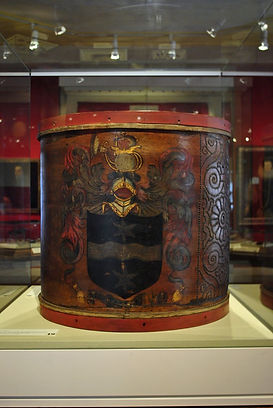
A Reproduction of Drake's Drum
As I’ve recently been looking at the spiritual relevance of some folklore and legends I thought it would be an interesting sideline to look at the story of Drake's Drum. I’ve always found it fascinating that in the story of Britain, and also in many other countries, God raises up men and women to save the nation in its darkest times.
In the 16th century it is hard to exaggerate the menace that the Spanish empire posed to England. In 1588, the global Spanish Empire had an estimated population of 20 to 25 million people. This total encompassed the Iberian Peninsula, extensive overseas colonies in Latin America and the Philippines, and various European territories ruled by the Spanish Crown. In the same year (the year of the Spanish Armada), the population of England was estimated to be between 3.8 and 4 million people.
16th century Spain had been the enemy of England, determined to crush the nation that had broken with Rome and bring it back under papal control. The English were constantly under the shadow of this threat and several Elizabethan seafarers took it upon themselves to fight back against Spanish control of the seas and of the New World. Foremost among these was Sir Francis Drake who harassed Spanish ships and ports to such an extent that he became a bogeyman figure in Spanish culture. The Spanish called Sir Francis Drake El Draque, which translates to "The Dragon" in English. Drake’s adventures, in particular his circumnavigation of the world and his role in defeating the Spanish Armada have become legendary. However, here I want to focus on the story of Drake’s drum.
The drum in question was made famous in a poem by Sir Henry Newbolt. The drum itself is preserved at Buckland Abbey in Devon. It is a side or snare drum, 21 inches high with a barrel of walnut. It is said to have accompanied Drake on his voyage around the world. Robert Hunt in his “Popular Romances of the West of England”, first published in 1865, adds to the legend. He says that the housekeeper at Buckland Abbey, Betty Donithorne, assured him that if Drake ever heard the beat of the drum “he rises and has a revel”. Newbolt knew of such stories and in his poem “Drake’s Drum” published in 1896, he said that the drum could summon Drake from the dead whenever the country was in peril. According to Newbolt the dying Drake said:
"Take my drum to England, hang et by the shore,
Strike et when your powder's runnin' low;
If the Dons sight Devon, I'll quit the port o' Heaven,
An' drum them up the Channel as we drumm'd them long ago."
Over time the legend grew and took on new life during the two world wars. In 1918 some fishermen in Brixham, Devon, claimed they heard the drum the day the Battle of Jutland was fought. Even more surprisingly it was heard throbbing aboard HMS Royal Oak the day the German fleet surrendered to the British Grand Fleet at Scapa Flow in the Orkney Islands. The captain ordered a search to be made for the drummer but nothing could be found. The drumming continued until the German fleet hauled down its colours.
During the Second World War the legend reemerged. In September 1940 as the Luftwaffe lost its fight for mastery of the skies during the Battle of Britain, two army officers swore they heard the drum beat again on the Hampshire Downs.
Sir Francis Drake had a genuine strong faith in Jesus Christ. At the very height of his career he wrote to John Foxe, author of Foxe’s Book of Martyrs,
“Our enemies are many but our protector commandeth the whole world”. Drake inspired the whole nation of England with the courage to resist the gigantic menace of the Catholic world that sought to destroy it. In 1587 he addressed Francis Walsingham, one of queen Elizabeth’s ministers who was aboard his ship, the Elizabeth Bonaventure. He spoke of the coming inevitable conflict with Spain:
“There must be a beginning of any great matter, but the continuing unto the end until it be thoroughly finished yields the true glory”.
These words were later converted into a prayer which became extremely popular during the Second World War:
“O Lord God, when thou givest to thy servants to endeavour any great matter, grant us also to know that it is not the beginning, but the continuing of the same, until it be thoroughly finished, which yieldeth the true glory; through him who for the finishing of thy work laid down his life for us, our Redeemer, Jesus Christ. Amen. “
This prayer was repeated during the National day of Prayer on 23rd March 1941. If you are interested in the incredible answers to prayer following national days of prayer in Britain in both World Wars see the series of videos entitled “Prayer saves a Nation”. Wartime Britain took the words of Drake's prayer to heart and they were repeated many times throughout the conflict
Legends are important because they inspire us. The story of Drake’s drum may be a legend but it is a legend that has continued to remind people of the qualities that Drake represented. Faith, courage, daring and love of country. When people believe they hear the beating of the drum they are remembering those indomitable qualities.
The World Under the Earth
The Biblical Connection with Pixies, Piskies, Leprechauns and Other Legendary Creatures.
The World Under the Earth Part 1. The Biblical Connection with Pixies, Piskies, Leprechauns and Other Legendary Creatures.
The World Under the Earth Part 2. The Biblical Connection with Pixies, Piskies, Leprechauns and Other Legendary Creatures. Where do they come from?
I’ve previously done videos on dragons and giants. Dragons (dinosaurs) died out sometime in the middle ages. Serpents, such as Leviathan, were basically demonic in nature because of their relation to the serpent in the Garden of Eden but other “dragons” such as the Behemoth were simply animals that struggled to adjust to the post flood world when the atmosphere was changed. Giants were basically demonic in nature because their forebears, the angels, had rebelled against God.
But what of the other supernatural creatures of folklore such as pixies, elves, fairies and so on. I’ve been thinking about this because of things I have heard. For example, several years ago the young son of one of the previous pastors of my church saw various imp like creatures who had come off the moor (Dartmoor) and invaded the house. He knew enough to rebuke them in the name of Jesus and they had to leave. There are countless legends about supernatural creatures on Dartmoor. I myself had the experience of waking up, when I was on holiday, in Cornwall, and seeing a little man in a green suit (like a leprechaun) at the end of my bed. It stayed for a moment and then it was gone.
It’s important to me to try and understand what these things are. Are they real or imaginary. Obviously I look at everything in the context of the bible and so I want to examine what these things actually are spiritually. Magic and fantasy are big business. Harry Potter is the best selling book series in history. It is also the highest grossing film franchise. Witchcraft is clearly demonic in origin as it is rooted in rebellion against God
[1Sa 15:23 KJV] 23 For rebellion [is as] the sin of witchcraft,
but what of all the other magical creatures that are often connected with it?
Before the arrival of Christianity the world was in a different state spiritually. Many spiritual forces operated on the earth which are remembered in folklore but which were gradually driven underground by the spread of Christianity and by the power of the Holy Spirit in the world.
My bible (Authorised Version) uses the expression “under the earth” four times. Here is what it says In the Book of Philippians.
[Phl 2:10 KJV] 10 That at the name of Jesus every knee should bow, of [things] in heaven, and [things] in earth, and [things] under the earth;
This is not referring to Sheol, the realm of the dead, as different words are used to describe this place. It is referring to creatures that live under the earth
[Rev 5:13 KJV] 13 And every creature which is in heaven, and on the earth, and under the earth, and such as are in the sea, and all that are in them…..
In the British Isles we have a vast amount of folklore relating to creatures that live under the earth. Scotland has Siths, Brownies, Ghillie Dhus and Trows (trolls). Wales has the Ellyllon, the Pwca (gremlins), and the Tylwyth Teg. England has goblins, gnomes, fairies, pixies (Cornish Piscies) and so on. Ireland has Síógs (sprites), leprechauns and Aos Sí. This last translates to "people of the mounds." They are a hidden race of supernatural beings often said to be ancient gods or spirits who were driven underground by invading mortals.
For me, the clearest explanation of what happened to these creatures comes from Irish sources. There are several sources for ancient Irish history which all rely on ancient source material that is now lost. One of them is the Lebor Gabála Érenn (literally "The Book of Ireland's Taking") known in English as The Book of Invasions. It is a collection of poems and prose narratives in the Irish language intended to be a history of Ireland and the Irish from the creation of the world to the Middle Ages.
It tells the story of Ireland being settled six times by six groups of people. Ireland, like Britain, was originally inhabited by giants who needed to be fought and they seem to have been there from the time of the Flood. If you are interested here is a chart of the six settlements, or invasions, of Ireland.
.jpg)
The World Under the Earth Part 3. The Biblical Connection with Pixies, Piskies, Leprechauns and Other Legendary Creatures. What they actually are.

For the purposes of this video I want to pick up the story with the Tuatha Dé Danann. (folk of the Goddess danu). They are a supernatural race in Irish mythology. Many of them are thought to represent deities of pre-Christian Gaelic Ireland. they were the fifth group to invade Ireland, arriving after the Fir Bolg, the fourth group of people to arrive in Ireland. The traditional bitter rivals of the Tuatha Dé Danann were the Fomorians.
The Fomorians are a supernatural, often monstrous race in Irish mythology. Believed to originate from beneath the sea or earth, they represent primordial chaos and destructive natural forces.The Tuatha Dé Danann ultimately defeated the Fomorians. This decisive victory occurred during the legendary Second Battle of Mag Tuired (Moytura), which took place on a plain in present-day County Sligo
There are some interesting things about the Tuatha Dé Danann. They were not human but supernatural and were essentially opposed to mortal men. They brought with them four magical items from the northern land where they originated.
1.The Stone of Destiny (Lia Fáil): A sacred stone that would roar or scream when the rightful king of Ireland stood upon it.
2. The Sword of Light (Claiomh Solais): An unbeatable blade wielded by their king, Nuada.
3. The Spear of Lugh: A blazing, magically accurate weapon.
4.The Cauldron of the Dagda: A bottomless pot that ensured no one ever left hungry.
Similar items appear in other legends such as the sword (Excalibur) in the stone story from Arthurian legend.
When the mortal Milesians (the ancestors of modern Irish people) invaded, the Tuatha Dé Danann were defeated. But it was agreed that the mortal Milesians would be allotted the portion above ground and the portion underground to the Tuath Dé. So, rather than dying out, they retreated into the sídhe (burial mounds) and the Otherworld. Over centuries, they evolved into the concept of Irish fairies.
I think this is a good example of what happened to all the supernatural beings on the earth when mankind arrived. God has given the earth to mankind
[Psa 115:16 KJV] 16 The heaven, [even] the heavens, [are] the LORD'S: but the earth hath he given to the children of men.
Even Satan himself does not have power on the earth unless he can control man. All spirits of the earth that have not bowed the knee to the almighty God have had to retreat before man and now live under the earth. They can only have influence if man in some way allows them to have influence. I find it interesting that the giants of the land of Canaan could not stand before the Israelites and had to flee all over the earth. Similarly dragons had to find remote places to live away from mankind. With the coming of Christianity and the influence of the Holy Spirit, in power, in the world everything changed again. Dragons and giants gradually started to die out, in particular with the spread of the church.
The supernatural spirits which are know as pixies, leprechauns and fairies retreated underground but the folk memory of their mischievousness remains. Nearly all the folk stories involve them trapping and ensnaring mortal people in some way.
The fairy stories we have all heard make these creatures appear quaint, magical and fascinating. However they are actually evil spirits which we should not attempt to summon up or communicate with. There are countless legends that I could choose to illustrate this but here is one that shows how the devil can trick us.
There has always been a battle in this area between light and dark. For example in the 7th century the abbot of Glastonbury was a man known as Saint Collen. Legend has it that he was invited by two demons to meet the king of the underworld on top of Glastonbury Tor. As they ascended, an awe-inspiring castle materialized before them. Its splendor was unmatched, adorned with resplendent troops, musicians, steeds, and maidens befitting a majestic king's court. St Collen was welcomed with honour to join the king at his table. However he was not fooled and dispelled the whole illusion with holy water. This event was chronicled and It epitomizes the supernatural and occult power deeply embedded in Glastonbury's legendary heritage.
If you want to know more about Glastonbury in particular I have done a video on “Glastonbury Festival. Its Occult Roots”. Satan uses magic and superstition to trap us and entangle us in his web of evil. This is why we should never get involved with fantasy and magic however enticing it seems. When the church is removed from the earth all these evil spirits will be released from under the earth and return to torment mankind.
[Rev 9:2-3 KJV] 2 And he opened the bottomless pit; and there arose a smoke out of the pit, as the smoke of a great furnace; and the sun and the air were darkened by reason of the smoke of the pit. 3 And there came out of the smoke locusts upon the earth: and unto them was given power, as the scorpions of the earth have power.
This is what is awaiting all of mankind who have not bowed the knee to Jesus Christ. So, throw your Harry Potter books away and anything else that makes sorcery and superstition look fascinating. There is a wonderful world awaiting all of us who believe. It is called heaven and it is beyond all that we can believe or imagine.